The $800–$1,500 Sold Picture
A used Fender American Professional II Precision Bass currently sits in a Reverb guide range of about $885–$1,318, based on more than 760 Good-to-Mint orders. That is the center of the $800–$1,500 used bass market in 2026: a passive USA P-Bass that still trades near two-thirds of a roughly $1,700–$1,890 new ticket.
Put an active circuit on a comparable Fender and the band widens. The American Ultra Jazz Bass — 18V preamp, same company, overlapping years — has recently sold at $1,243–$1,900 on Reverb, averaging about $1,500. New street on that model is still around $2,400. You are not looking at a higher floor. You are looking at a higher starting price and a fatter haircut.
Those two spreads are why shoppers hunting active vs passive bass sold prices eBay Reverb results should ignore the old line that extra electronics must be worth more later. In this price band, a preamp changes the ceiling. It also changes how far a listing can fall.
Active vs Passive Bass Sold Prices on eBay and Reverb
Reverb price guides are the cleanest public sold set. eBay completed sales on the same models usually land a bit lower after Best Offer and shipping — often $50–$150 under the Reverb midpoint, especially on five-strings and Mexican actives. Treat the ranges below as approximate bands from recent guides and completed sales, not a formal 18-month census. Asking prices still sit well above what actually closes.
Passive Fenders that actually close in this band
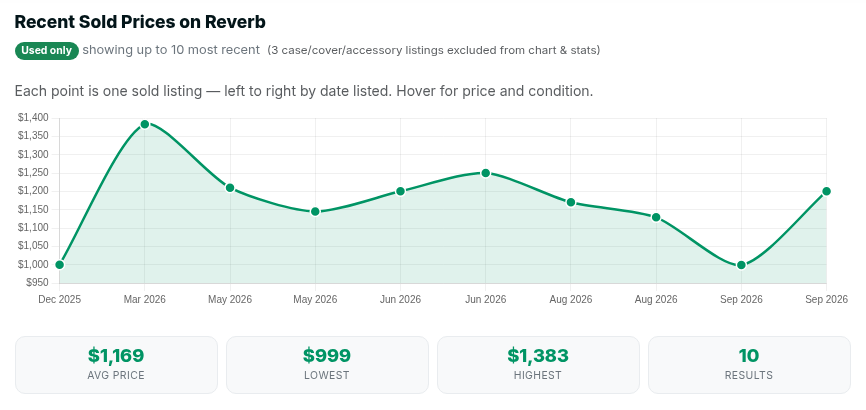
- American Professional II Precision Bass: $885–$1,318 on 763 orders. Recent completed sales include $900 Good, $1,000–$1,173 Very Good/Excellent, and Mint outliers above $1,600. Monthly used averages drifted from about $1,050 toward $1,250 through late 2025 — firm, not collapsing.
- American Professional II Jazz Bass: $925–$1,490 in recent Reverb solds. New was about $1,740.
- American Professional Precision (2017–2019): $799–$1,318 on 550-plus orders. The previous passive USA P now overlaps the bottom of the same band.
The pattern is tight. Most Excellent four-string Pro II basses close between $1,100 and $1,250. Days on market stay short because every working player already knows the instrument.
Active Fenders in the same money
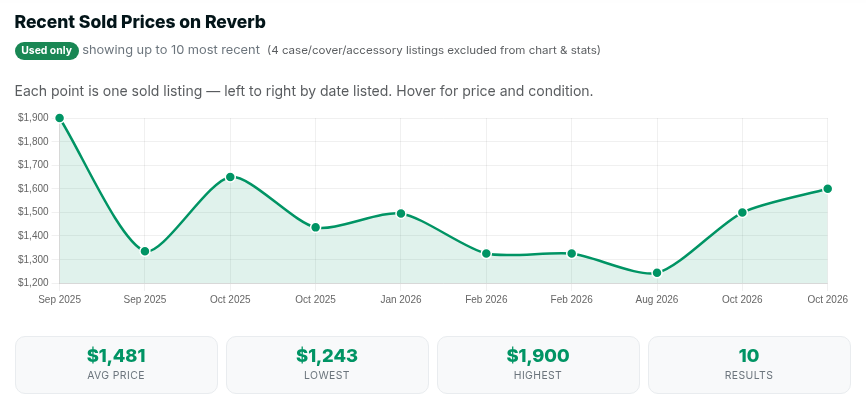
- American Ultra Jazz Bass: $1,243–$1,900 in recent Reverb solds, averaging about $1,500 (the sample includes five-string V models). Retention from street is closer to 62% versus about 66–68% on the Pro II.
- American Ultra Jazz Bass V: $1,335–$2,189 in recent Reverb solds, averaging about $1,700. The five-string premium is real, but so is the extra time to sell.
- American Deluxe Precision Bass (2004–2015): roughly $1,100–$3,250 in recent Reverb solds, many of them five-string V models. Closes range from $1,100 Very Good to $2,000-plus Excellent. That is a spread of well over $1,000 on one model family — much wider than the Pro II P.
- Player Plus Precision Bass (active MIM): $530–$935 in recent Reverb solds, averaging about $700. New was about $1,000–$1,150. This one mostly sits below the $800–$1,500 used band, not in it. Recent solds cluster $640–$790.
A passive Player Precision has recently sold at $225–$785, averaging about $545. The active Player Plus started higher new and still depreciates harder in percentage terms — a similar or larger percentage off street than the passive Player. The extra knobs did not protect the resale number.
Depreciation from new versus the last 18 months of used sales
Two clocks matter. Versus original street, passive USA Fenders in this band keep more of the sticker. Versus the last 18 months of used comps, neither side has crashed. Pro II P monthly averages moved up through late 2025. Ultra Jazz averages also firmed, from roughly $1,300 toward $1,550. The used market has been stable-to-firm. The gap is how much you lost on the way from the music store to Reverb, and how wide the left tail is when a listing mentions a preamp, a battery box, or untested electronics.
Approximate retention from new, using Reverb midpoints:
- Pro II P-Bass: about $1,700–$1,890 new to ~$1,150 used — roughly 32–35% down.
- Pro II Jazz: about $1,740 new to ~$1,150 used — similar.
- Ultra Jazz: about $2,400 new to ~$1,500 used — roughly 38% down.
- Player Plus P: about $1,100 new to ~$700 used — roughly 36% down.
Pull current sold price research on SearchMusicGear against live asks rather than last year’s street.
Why Active Electronics Often Subtract at Resale
Buyers in this band are mostly players, not collectors. A passive P or J is a known quantity. An active preamp adds three frictions that show up in sold prices:
- Diagnosis risk. Active basses flagged with preamp issues routinely list 15–25% below market because a buyer cannot tell if the problem is a battery, a noisy blend pot, or a dead preamp. That haircut is real on Reverb and worse on eBay, where returns are messier.
- Smaller buyer pool. Plenty of gigging bassists still want a battery-free P-Bass they can DI or slam into an amp. Every one of those shoppers is a non-bidder on an Ultra.
- A feature that ages like a pedal, not a body. Alder, a maple neck, and a split-coil do not go out of date. A 9V or 18V circuit from 2012 does. American Deluxe actives still sell, but the spread between a clean example and a cracked battery-cover example is the story.
When an Active Bass Still Holds
The exception is not active versus passive. It is whether the bass was designed around the preamp. Ernie Ball Music Man StingRay Specials typically close well above the Pro II P price. Buyers want that humbucker-and-preamp voice. They are not shopping it against a Pro II P. Sterling Ray34s are cheaper (roughly $475–$900 in recent solds, averaging about $700) because they are the Indonesian version of the same idea, not because active itself is poison.
Switchable active/passive circuits (G&L L-2000, some Warwicks) sit in the middle. You can pull the battery and still have a usable bass, which shrinks the diagnosis discount. If you are buying to hold value, that switch is worth more than a third EQ band.
Five-string actives are a liquidity problem of their own. Player Plus Jazz V solds in recent months include $660, $749, $800, $920, and $999 — a messy stack for a bass that listed new near $1,100. The extra string helps the player and slows the sale.
Flip Math If You Buy the Bottom of the Band
Reverb’s fee plus shipping means you need roughly 18–25% gross to net double digits. In this band that looks like:
- Passive Pro II P: Buy Good at $900–$1,000, sell Excellent with case at $1,150–$1,250. Gross $150–$350 on about $1,000 tied up. Condition photos and a straight neck do more than any EQ story.
- Active Ultra Jazz: Buy Very Good at $1,250–$1,350, sell Mint with case at $1,500–$1,650. The dollar spread is larger, but one noisy preamp listing will sit. Budget extra days.
- Active Player Plus P: Buy $530–$650, sell $700–$790. That can clear 25% gross if you avoid broken battery-cover examples. It is not $800–$1,500 money, but it is the active model with the most room under the sold ceiling.
Do not flip on asking prices. Deal Desk is built for this: match a buy list to new Reverb and eBay listings, then Flip, Watch, or Pass against sold comps instead of the seller’s original retail.
Price Yours Against Solds, Not the Preamp Story
If you are listing a passive Pro II in Excellent with the molded case, $1,150–$1,250 is the conversation, not $1,499 because it is USA. If you are listing an Ultra, lead with weight, battery type, and that the preamp is quiet. Shoppers comparing active vs passive already know what the circuit does. They are shopping the sold band.
Before you bid or list, run the exact model through SearchMusicGear sold price research and the Gear Value tool. Search across Reverb and eBay in one place, then set the ask on completed sales from the last 90 days, not the original street price and not the three Mint listings that have not moved. In the $800–$1,500 bass market in 2026, passive still holds a tighter, more liquid resale number. Active holds when the bass was built to be active — not when extra electronics were added to a P or J the market already understood.