Start with what sold, not what is listed
A studio compressor flip lives or dies on one question: what did the last few units actually sell for? Asking prices on Reverb and eBay are hopes. Completed sales are evidence. This guide walks through the check using SearchMusicGear's free sold price research tool on three popular compressors, and shows why most of them are tighter flips than they look.
One honest limit up front: the tool shows up to 10 recent Reverb sales per search, with the date each was listed, price and condition. It does not show days on market, so it cannot tell you whether a unit sold in under 10 days. It tells you the price band. Speed you have to judge from live listings and watchers.
How to read the sold band
Search the exact model, then use only stock, complete units. Throw out anything marked modded, card-only or accessory listings, and matched pairs. Then note four things:
- The low and high of the remaining sales
- Where most of the sales cluster
- Condition on each sale (Good vs Excellent)
- How old the newest sales are, since the band can drift
Then work backwards from the exit. Take a realistic sale price, subtract Reverb's selling and payment fees (roughly 8–9% all in, so check the current fee schedule) and shipping, and see what is left. The same math applies when you are pricing a unit you already own, which is what the gear value tool is for.
dbx 160X: buy near the bottom or skip
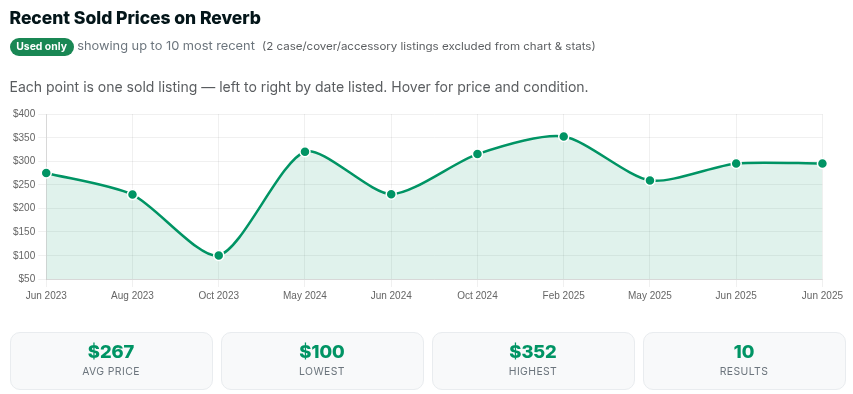
On a recent look at dbx 160X sold prices, eight stock single-channel units sold between $229 and $352, averaging about $282. Two Excellent units both sold at $295 and a Good one at $259. A Good unit went for $229 and an older Good one for $275. The tool's headline average is lower because it also counts a $99.99 option card, so strip accessories before you trust the average.
The flip math: buy at $229, sell at $295, and the gross gain is $66, about 29%. After fees of roughly 8–9% that drops to around 18%, short of a 20% target before shipping. The 160X only works if you buy under the cluster and sell into the Excellent prices.
FMR Audio RNC 1773: cheap, liquid, thin margin
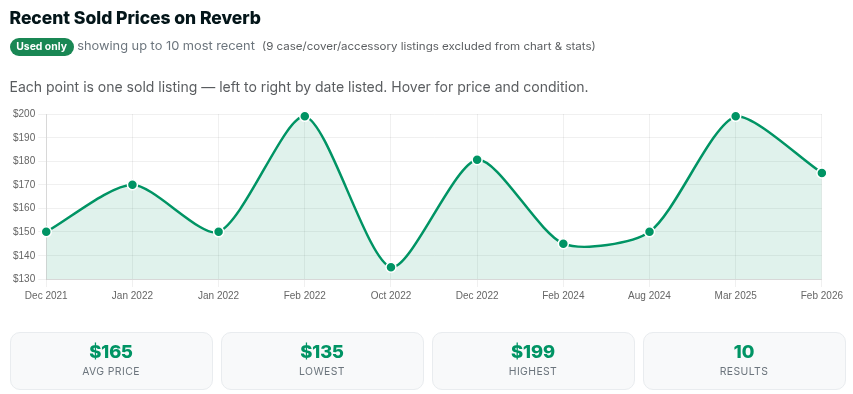
In the FMR Audio RNC 1773 sold prices, single units mostly sold between about $135 and $180, with a high of $199 for a Very Good unit in 2022. One Very Good unit went for $99 in 2025. Treat that as an outlier, not a price you can plan around.
A $99 buy sold at $175 would be a big percentage, but one sale is not a market. If you pay $135 and sell at $175, you gross about 30% on only $40, and fees plus shipping take most of that. The RNC is the kind of unit where the dollars are small, so the percentage looks better than the profit.
Empirical Labs Distressor: real money, narrow room
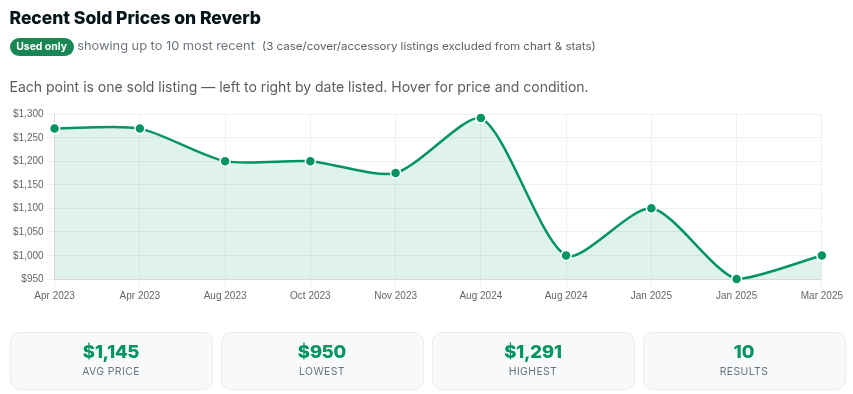
The Empirical Labs EL8 Distressor sold prices show ten sales from $950 to $1,291, averaging about $1,145. Sales clustered between $1,000 and $1,291.
Buy at $950 and sell at $1,200 and you gross about 26%, roughly $250. After fees of around 8–9% (about $100 on a $1,200 sale) that falls to around 15%, before shipping. At a $1,000 buy it is worse. The Distressor holds value, but a 20% net flip needs a buy well under the sold band.
Warm Audio WA-76: a tight band is a pass
Warm Audio WA-76 sold prices ran $415 to $500 across ten sales, averaging about $463. The newest of those were listed in 2022, so treat the band as dated. Even so, the gap from lowest to highest is only about 20% of the low price. Fees alone eat most of that, so a typical WA-76 buy cannot clear a 20% net.
Use the numbers to build a buy cap
Write your exit price first, take off fees and shipping, and then take off the margin you need. The result is your maximum bid. If a listing is asking more than that, pass or make a lower offer. Deal Desk lets you set a model and a price cap and then flags matching listings on Reverb and eBay as Flip, Watch or Pass, so you do not have to refresh searches by hand.
What to pass on
- Tight bands. If the high is less than about 25% above the low, fees leave almost nothing.
- Modded, incomplete or untested units. They do not belong in your comps, and they sell for different money.
- Pairs and kits. A matched pair is a different product from a single unit, so do not apply single-unit comps to it.
- One-off lows. A single cheap sale, like the $99 RNC, is not a price you will see again.
The takeaway is simple: stock-unit sold prices tell you how much room a compressor really has. For these three, the room is smaller than the headline percentages suggest, so check sold price research before you bid and use Deal Desk to catch the ones priced under the band.