
A Ludwig Classic Maple Downbeat in Good condition sold on Reverb for $1,610.99. An Excellent example of the same model closed at $1,600. One Mint kit brought $2,089; another Mint sold for $1,500. That is not a clean grade ladder. It is the trap.
Pull used drum kit sold prices by condition grade on Reverb over recent months and the same pattern shows up on acoustic shell packs and electronic kits: Mint often asks more, sits longer, and does not always close higher. Excellent and even Good player-grade sets move faster. When hardware, heads, or extras are in the box, they can outsell a cleaner shell pack.
This is completed-sale math, not a lecture about “character.” Checking sold price research on SearchMusicGear before you bid or list keeps the decision on actual Reverb and eBay closes instead of the Mint badge in the title.
Used drum kit sold prices by condition grade on Reverb
Reverb’s grades — Mint, Excellent, Very Good, Good — look orderly. Sold history is not. Price guides bundle Good-to-Mint into one band, which hides the inversion. The useful comparison is the transaction table: same model, recent months, sorted by condition and final price.
Kit comps are messier than guitars, so treat the figures below as recent ranges, not a census. Shipping is heavy. Local pickup distorts averages. A “kit” might be shells only or a full hardware-and-cymbal package. Sample sizes come from Reverb price-guide order histories and recent eBay sold listings.
What the bands actually look like:
- Yamaha Stage Custom Birch 5-piece: Reverb guide about $283–$601 on 55 Good-to-Mint orders. Recent Mint sales clustered $601–$757.
- DW Collector’s Series (all models): about $1,378–$2,617 on 805 orders — a spread so wide the badge barely helps. Recent Excellent closes $2,249–$3,999; a Very Good at $2,500.
- Ludwig Vistalite Big Beat 4-piece: $883–$1,853 on 129 orders. Very Good sold $1,399–$2,200; Excellent $1,395 and $1,549.
- Ludwig Classic Maple Downbeat: $1,207–$2,067 on 123 orders. Good $1,611; Excellent $1,600–$1,700; Mint $1,500–$2,499.
- Roland TD-07KVX: $666–$1,009 on 73 orders. Mint $1,068–$1,187; Excellent $700–$989.
- Roland TD-17KV / KVX / KVX2: Good-to-Mint bands roughly $679–$998, $867–$1,377, and $919–$1,487. Excellent often closes inside 10% of Mint; Good can overlap Excellent.
- Roland VAD307: $1,281–$2,018 on 53 orders. Mint stacked at $2,185; Excellent $1,600–$1,800; Very Good $1,500.
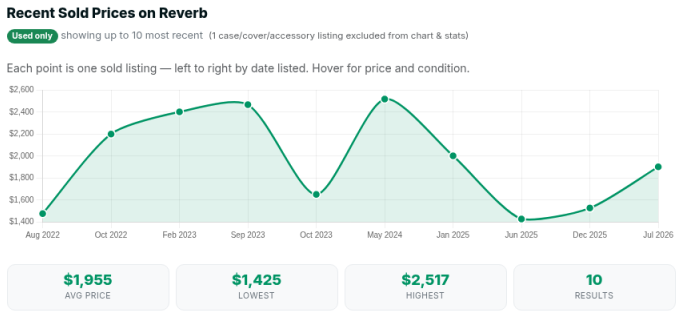
On working acoustic kits, Excellent is the liquidity grade. Mint is a collector tax that only sometimes gets paid. On electronic kits, Mint still commands a real premium — but Excellent often lands close, and Good can print next to Excellent when every pad and the module work.
Acoustic kits: where Good closes next to Excellent
The Stage Custom numbers look like a Mint premium until you stack them against the rest of the market. Typical used Stage Customs in Good shape still trade around $400–$800 depending on sizes and finish. Sweetwater’s Gear Exchange price advisor puts a “sell fast” number near $585 with a 5–10 day window versus a max-value ask around $716 that takes longer. A live Good Stage Custom at $495 has sat for months with views and offers but no close. Grade did not save it. Ask and configuration did.
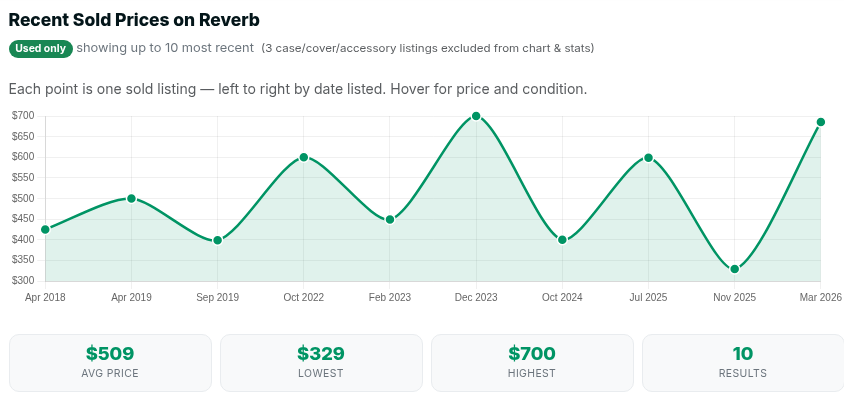
DW Collector’s is the other extreme. That $1,378–$2,617 all-models guide is almost useless as a single number. Recent Mint sales print at both $1,600 and $899 — the last almost certainly an incomplete or mismatched pack. Typical Excellent 4-piece maple kits still live in a $2,500–$5,000 street band. An eBay Collectors 10/12/14/22 sold at $2,700. Finish, piece count, and whether hardware is included swamp the grade badge.
Vintage is where the inversion is loudest. On Vistalite Big Beat comps, Very Good outsold Excellent. Color, originality, and whether the acrylic is crazed matter more than whether the seller picked Excellent or Very Good. Same story on 1960s Ludwig Downbeat outfits (guide $1,248–$2,547 on 156 orders): Good $1,549, Very Good $1,450–$1,900, Mint $3,475, Excellent $2,250–$3,600. Mint can print when the wrap is a collector finish. It does not print on a player black duco.
Workhorse kits follow a simpler rule of thumb: used drums in good shape often land at 40–60% of original retail, and rough examples 20–35%. Pearl Export Fair-to-Good comps still sit around $150–$400. A Good 4-piece Export with no snare asked $270 and sat for months. eBay sold a Forum 3-piece at $300 and a Roadshow with missing rods at $395. Gretsch Renown Maple in Good typically $600–$1,400; a Renown ’57 3-piece in Good sold at $799.
Electronic kits: Mint still costs extra — until it doesn’t
E-kits behave more like electronics than shells. Completeness, mesh heads, and a working module are binary. That is why Mint still shows up as a real dollar gap on Roland.
On the TD-07KVX, the Mint premium is about $150–$400, not a different product. On the VAD307, four Mint sales stacked at $2,185 against Excellent at $1,600 and $1,800 — a $400–$585 Mint tax for a kit that already looks like an acoustic from the audience. The TD-17 family is flatter: a TD-17KV Excellent closed at $729 and a Good at $750, with Mint at $800–$947. A TD-17KVX Good closed at $950 against Excellent $995–$1,212. TD-17KVX2 Excellent sales ran $998–$1,400 with Mint at $1,520.
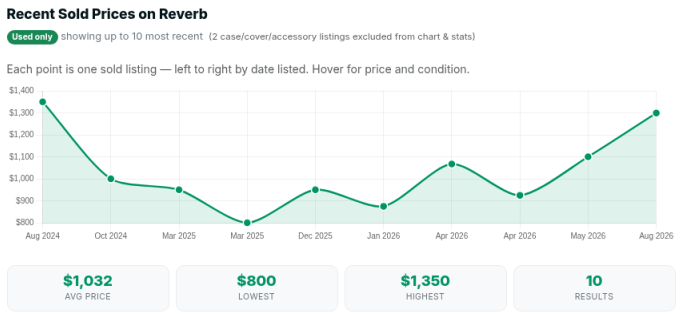
Entry Alesis Nitro Max is even flatter. Sweetwater’s used advisor: about $207–$307, sell-fast $259 in roughly 5–10 days, max value $307. Reverb Excellent asks cluster $260–$375. Mint open-box listings at $360 sit for weeks next to Excellent kits already discounted into the $290s. Paying Mint here buys packaging, not feel.
Why a lower grade can sell for more
The grade is a photo grade. Buyers pay for a playable configuration.
- Hardware and extras. A Good kit with stands, throne, and cymbals beats a Mint shell pack every week.
- Honest Very Good vs inflated Mint. Stick marks on hoops do not change birch. Overgraded Mint gets offered down.
- Pickup vs ship. Local Excellent at $1,200 net of $0 freight beats Mint at $1,400 plus a $250–$400 freight quote.
- Finish and sizes. Twenty-inch jazz sizes and desirable wraps move; 22/12/13/16 black wraps sit, Mint or not.
- Function on e-kits. A Good TD-17 with every pad triggering outsells a Mint kit missing the module.
Days-to-sell: Mint is the slow lane
Reverb has long cited about three weeks as a typical time-to-sale across the site. Used-gear shops that sell online often see under three weeks at 10–20% margin; brick inventory on drums can sit three to four months. Full kits are heavier and slower than guitars.
Public velocity data is directional, not a stopwatch. Sweetwater’s Gear Exchange explicitly prices “sell fast” 5–10 days below max value. Vintage sellers on drum forums still talk 6–12 months for kits that are not the lowest ask. Live Reverb inventory tells the same story in price drops: DW Collector’s listed Mint, originally $7,589, now $4,326; another rare Mint custom from $10,000 to $7,000. Those are not 21-day flips. They are listings waiting for a collector who wants that exact finish.
Excellent player-grade kits at the bottom of the sold band get the gigging buyers. Those buyers search, compare two photos, and click. They do not wait for a closet-queen Mint to come down $400.
What the spread is worth to buyers and sellers
If you are buying to play, shop Excellent and honest Good. On a Stage Custom, that is roughly $400–$600 instead of chasing Mint at $680–$757. On a TD-17KV, Excellent around $730 versus Mint around $950 is $200 you can put into a better throne or a used cymbal. On a VAD307, skipping Mint saves about $400–$585.
Run the flip the other way. Reverb’s fee plus shipping a 5-piece is not a guitar-in-a-gig-bag problem. A $150–$300 freight bill plus Reverb’s 5% selling fee and payment processing eats the Mint premium unless you already bought at the floor. Buy the Excellent kit at the low end of the 90-day sold band, recut heads if needed, photograph bearing edges and interiors, and list in Excellent at the median close — not at fantasy Mint. Deal Desk on SearchMusicGear is built for that workflow: a buy list, new Reverb and eBay matches, and sold comps on the same card so you can Flip, Watch, or Pass without guessing.
Sellers who insist on Mint because the kit lived in a smoke-free spare room still have to beat the last ten sold prices, not their original receipt. If comparable Excellent examples closed at $1,600, a Mint ask of $2,400 is how you get a 90-day listing with three price drops. Gear value tools that pull recent solds will show that before you write the title.
eBay complicates the grade story because most drum kits there are simply “Used.” The solds still cluster: cheap complete starter kits $180–$400, player mid boxes $500–$1,100, name-brand maple in the same bands Reverb prints. Condition notes and photos do the work Reverb’s dropdown does. Same rule: a complete, honestly worn kit with hardware included closes. A “mint” shell pack with a $400 ship quote does not.
The condition trap is paying for a label. Recent used drum kit sold prices by condition grade on Reverb say the playable Excellent kit is the one that actually leaves the warehouse. Use search to line up live asks against those solds before you overpay for a badge.