Reverb sold listings from the last 90 days still leave a 25%+ net on a short list of Roland, Akai, and Elektron drum machines — but only if you buy the bottom of the completed-sale band, not the median ask. Reverb’s price guides put a used TR-8S around $428–$605 on more than 2,000 Good-to-Mint orders, while an original Digitakt sits at $408–$565 across 4,600-plus sales. Those midpoints are not the flip. The flip is the spread between neglected Good sales (or incomplete eBay lots) and typical Excellent, boxed comps after Reverb’s 8.19% + $0.49 fee stack.
Checking sold price research on SearchMusicGear before you bid or list keeps that spread tied to completed Reverb and eBay sales instead of the asking prices that sit 10–20% above what actually clears.
Where used drum machine sold prices Reverb flips actually come from
High-velocity drum machines do not all behave the same. Successor launches dump the previous generation (Digitakt Mk1 after Digitakt II). Compact siblings undercut the flagship (TR-6S versus TR-8S). Condition and completeness do more work than brand: a Good MPC Live II with no box can close near $460 while Excellent units in the same 90-day window land in the mid-$600s. GearBook’s Q1 2026 tracker also flagged an Akai MPC X SE average that fell 28.3% versus Q4 2025 — a reminder that a falling knife is not a flip, even when the sticker looks cheap.
The six units below are the opposite case: liquid enough to sell in days, with a documented low quartile you can still buy against a stable Excellent sold band. Figures are approximate, drawn from Reverb price guides, recent transaction tables, and live asks. Always re-check the last 30 days; a $40 move in either direction wipes a thin 25%.
The fee line that turns a 40% spread into 25%
Reverb currently pays out about 91.8% of the sale. Standard math is a 5% selling fee plus 3.19% + $0.49 payment processing, charged on item price plus any shipping you collect. If you offer free shipping, you eat the label too. Worked from that stack:
- A $315 TR-6S sale costs about $26 in fees. After a $15 label and a $225 buy, net is roughly $49 — about 22%, not 25%.
- The same machine bought at $217 and sold at $325 with a $12 label nets about $69, or ~32%.
- That is the whole article: 25%+ is a low-quartile buy plus an Excellent/boxed sell, not median-to-median.
Run the buy against SearchMusicGear gear value and the live ask through Deal Desk so you are not guessing whether a $40 offer still clears fees.
Roland: the TR-6S and the dumped original TR-8
Roland’s AIRA line is where volume and successor pressure stack. The TR-8S is too tight for a reliable 25% net unless it is missing a PSU or sitting in a local-pickup fire sale. The two boxes next to it still have room.
TR-6S
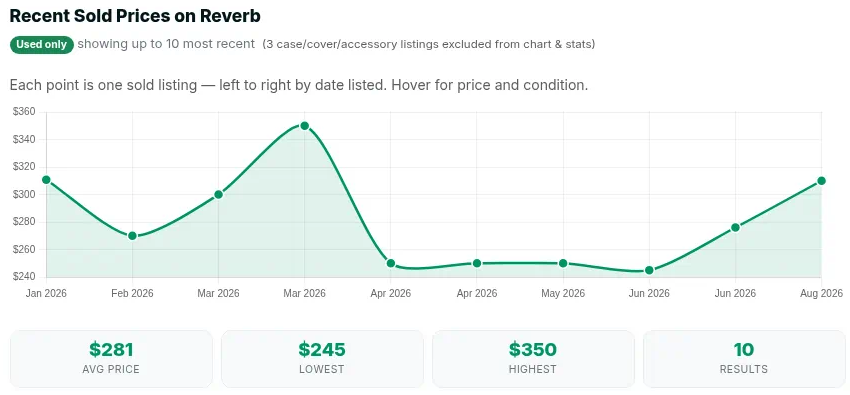
Reverb’s guide on 844 Good-to-Mint orders sits at $217–$325. Recent completed sales cluster around $290–$325, with Mint outliers in the $360s. Live Excellent asks often open at $320–$400 and get walked down. Sweetwater Gear Exchange has moved mint boxed units in the $315 area. The buy is the $217–$240 Good/Very Good sale or a local $275 that still has the box and USB cable. Sell Excellent, boxed, at $305–$325. Buy $217 / sell $325 / $12 ship is the 30%+ example above. Miss the box and you are selling back into the $280s, which does not pay.
Original AIRA TR-8
The TR-8S ate this market. Gear Exchange’s suggested used band is roughly $156–$231; an eBay used sale printed at $260; Reverb UK Excellent-with-box asks still sit around £330–£352. US Reverb Excellent comps are thinner, so treat the sell side as approximate and confirm with sold filters before you size the buy. The trade is cross-platform: pick up a dumped TR-8 on eBay or Gear Exchange in the high $100s to low $200s, then list complete on Reverb with the original PSU and box toward $330. Buy $210 / sell $330 / $20 ship nets about $72 after fees (~35%). Without the 7x7 expansion or the box, price it as a player unit and the margin collapses.
Akai: MPC One and MPC Live II
Akai standalone pads move every week, which is what you want for a flip that is supposed to be quick. The spread lives in condition, storage, and whether the seller photographed a scuffed bottom and called it Excellent.
MPC One (original black)
Reverb guide: $311–$435 on 1,875 Good-to-Mint orders. Recent Excellent sales print $375–$428; Good/distressed comps have closed at $293 and $315. Do not confuse this with the One + (red) or the newer G2, which trade in different bands. Buy the original One at $293–$315 when pads are clean and the PSU is in the shot. Sell Excellent at $400–$428. Buy $293 / sell $428 / $15 ship nets about $84 after fees (~29%). A Gold or Retro edition is a different SKU — mixing them in comps is how people overpay.
MPC Live II
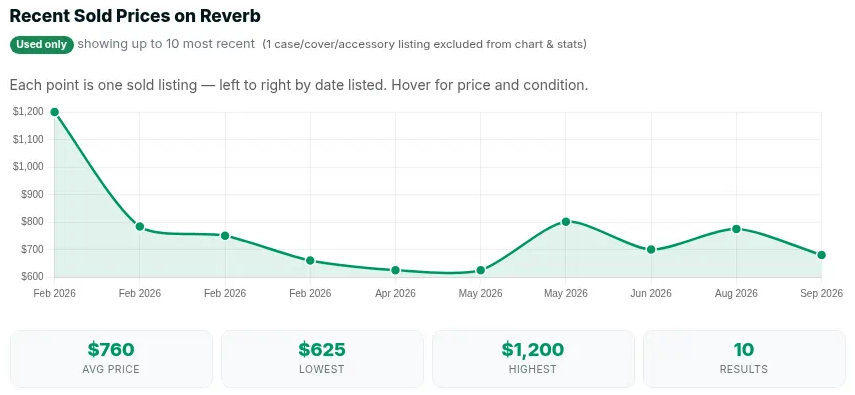
Widest dollar spread of the six. Reverb guide: $473–$746 on 1,267 orders. Recent Excellent sales sit $630–$677; a Good sale printed $459. Live asks of $775–$900 are not comps. Buy Good/Very Good, complete, at $459–$500. Sell clean Excellent with PSU at $650–$677. Buy $459 / sell $677 / $25 ship nets about $137 after fees (~30%). Internal SSD upgrades and expansion libraries can add a small premium, but only if you list them as transferable and a buyer actually wants them. Do not pay for someone else’s sample folder.
Elektron: Digitakt Mk1 and Analog Rytm Mk1
Elektron holds value better than most grooveboxes, which is why the median is a bad flip. The 25% lives on the Mk1 units that got repriced when the next box shipped.
Digitakt (2017–2024 Mk1)
Guide: $408–$565 on 4,612 orders. Recent sales run from a $382.50 Excellent print up through $490–$525, with a $600 outlier. Digitakt II used is a different market ($756–$940 guide) and is not this flip. Buy Mk1 at $380–$420, preferably with PSU and a decksaver or box. Sell Excellent boxed at $520–$550. Buy $382 / sell $550 / $18 ship nets about $104 after fees (~27%). Sell unboxed into the $440s and you are working for shipping tape. Overbridge and a fresh OS dump are free value; mention both in the listing.
Analog Rytm (original Mk1, not MkII)
Mk1 guide: $567–$830 on 916 orders, with recent Excellent sales around $680–$750 and Mint closer to $795. MkII is a separate, higher band ($894–$1,430 guide; recent Excellent often $1,100–$1,200). Mixing the two SKUs is the fastest way to invent a fake 40% spread. Buy Mk1 at the $567–$680 area when the analog voices are confirmed and the PSU is original. Sell Mint/boxed toward $795–$830. Buy $567 / sell $830 / $25 ship nets about $170 after fees (~30%). A $700 “great value” Mk1 ask against a $1,150 MkII listing is not a comparable; it is two products.
What kills the margin before you list
The 25% is real on these six and fake on almost everything next to them. A TR-8S bought at $500 against a $560 Excellent sold is a 12% gross before fees. Model:Samples and the Boutique TR-08 have $20–$40 total spread — enough for a player deal, not a flip. Syntakt’s $556–$745 guide looks wide until you try to buy at $550 and sell at $730 after fees and a $20 label (~18%).
- Missing PSU or no box knocks most of these into the Good band, which is where you are supposed to buy, not sell.
- Paying the median ask on a machine whose sold history is already the median. Offers close a huge share of Reverb sales; start from the last five solds, not the current gallery.
- Time. A 25% net that takes 45 days is a worse hourly rate than a 15% net that ships in a week. These six work because they actually sell.
- Shipping theater. Free shipping on a 6-pound Elektron with a $25 label is fine at $550+; it is fatal on a $230 TR-6S if you also underpriced the unit.
Use SearchMusicGear search to pull the exact SKU (Mk1 vs MkII, One vs One +, TR-8 vs TR-8S), then sold price research for the 90-day band, then Deal Desk on the live listing so the offer still clears 8.2% + label + your floor. If the buy is not in the low quartile of solds, skip it. The market is liquid enough that another neglected Digitakt or MPC One will show up this week.